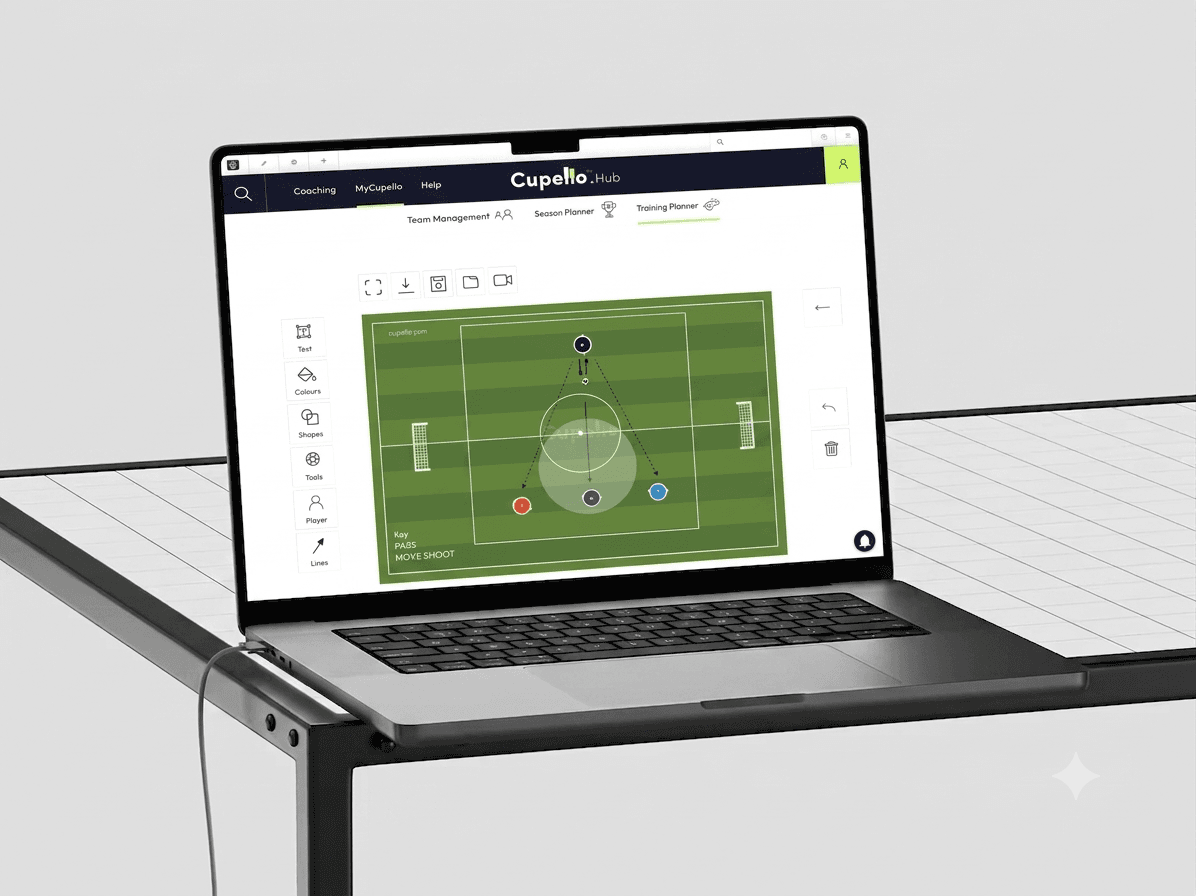
Interactive tactics board
A custom HTML5 Canvas workspace where coaches can arrange players and tactical elements directly on a football pitch.
Interactive Web Application
I developed Cupello’s interactive tactics board and core planning tools, giving coaches a practical way to create formations, design drills, organize sessions and communicate tactical ideas visually.
01Overview
Cupello is a football coaching platform created to help coaches plan sessions, build drills and communicate tactical ideas more effectively.
A central part of the experience is its interactive tactics board. Instead of planning with static diagrams, disconnected documents or physical whiteboards, coaches can work inside a visual digital environment designed around the way football sessions are actually prepared.
I built the board from scratch using JavaScript, Fabric.js and HTML5 Canvas. The project extended beyond drawing basic shapes on a pitch. The interface needed to support player positioning, annotations, tactical layouts, reusable drills, session planning and saved coaching resources while remaining approachable for non-technical users.
The result is a specialized application where coaches can move from an initial tactical idea to a structured training session inside one connected platform.
02Challenge
Football tactics are highly visual, but a useful digital tactics board also requires structure. Coaches need the freedom to sketch and experiment without losing the organization required to reuse their work later.
The interface had to make a complex set of interactions feel immediate. Objects needed to be selected, moved and positioned naturally. Drawing tools needed to work alongside player markers and tactical elements. The board also had to connect with the wider training planner, file manager and drill-management workflow.
03Solution
I created a custom tactics-board experience using Fabric.js as the interactive canvas layer and plain JavaScript for the surrounding application logic.
The football pitch acts as the visual workspace. Coaches can position tactical elements, organize players and illustrate ideas directly on the field. The board was integrated into the broader Cupello workflow rather than being treated as an isolated drawing widget.
The surrounding interface was designed to keep important controls accessible while preserving enough space for the pitch. Training content could be organized into drills and sessions, allowing the visual work created on the board to become part of a repeatable coaching process.
A custom HTML5 Canvas workspace where coaches can arrange players and tactical elements directly on a football pitch.
Natural object movement and positioning make it faster to experiment with formations, movement and spatial ideas.
Visual tools allow coaches to illustrate runs, zones, directions and coaching instructions.
Board content can support a broader session-planning workflow rather than remaining an isolated diagram.
Coaches can create and organize reusable training material for future sessions.
Supporting tools help keep coaching files, plans and exercises organized inside the platform.
04Technical approach
The technically important part of Cupello was managing the relationship between a visual canvas and the rest of a conventional web interface.
Fabric.js provided a structured way to work with interactive canvas objects, while custom JavaScript controlled application behavior, tools and user interactions. HTML and CSS were used to create the surrounding dashboard and planning interface, with PHP supporting the wider platform.
The board needed to preserve the responsiveness of a drawing application while fitting naturally into a session-planning product. The implementation therefore focused on clear canvas controls, predictable interaction states and a separation between the board data and the visual interface used to edit it.
Technical challenge
Interactive applications can quickly become difficult to understand when too many tools, states and object types compete for attention. I approached the interface as a coaching product rather than a general-purpose graphics editor.
Controls were organized around coaching actions, the football pitch remained visually dominant and the surrounding interface helped users move between planning, organizing and saving their work.
05Interface
06Outcome
Cupello became more than a static tactics-board demonstration. It developed into a practical planning environment combining an interactive pitch, drill creation, file organization and session planning.
The project demonstrates my ability to build complex browser-based interfaces from scratch and integrate them into a larger production platform. It also became one of the strongest examples of my work with Fabric.js and HTML5 Canvas.
The platform has been used by football coaches to visualize tactical ideas and prepare training material through a more organized digital workflow.
07Contribution
I build interactive tools, SaaS platforms, configurators, and technically challenging web products.